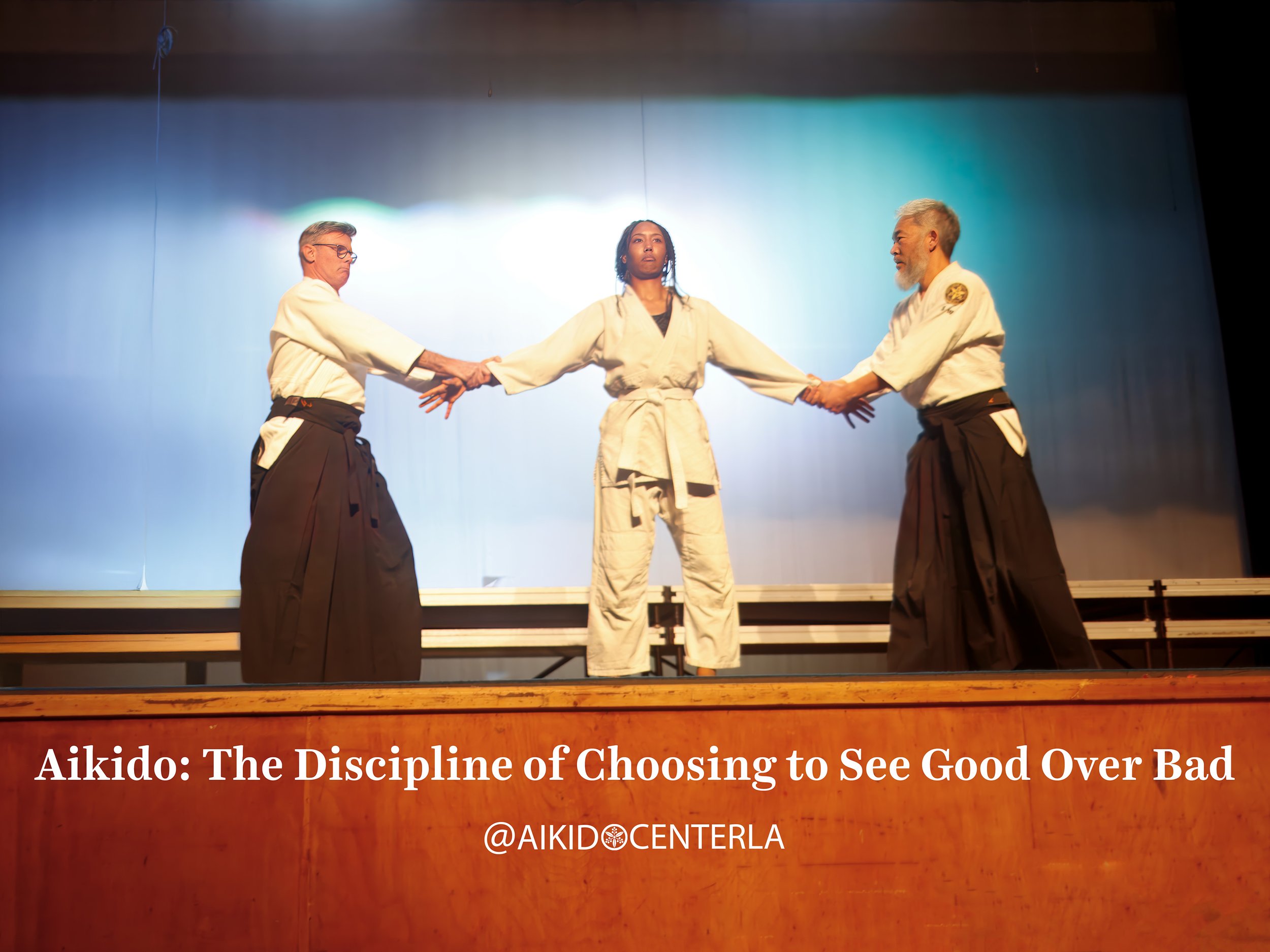
The best Aikidoists focus on the good.
As the year comes to an end, it is easy to discount the good and only focus on the bad. This is called negative bias where our minds hyper focus on all the goals that didn’t get achieved or the heights that we failed to reach.
There is nothing wrong with this way of thinking and many use it as strong motivation to start the next year strong. This way of thinking is evolutionarily based in our brains where we are hardwired to prioritize threats. Looking for threats activates our amygdala which is supposed to trigger a stronger and faster response for survival. This is sometimes referred to as the "bad is stronger than good" principle where negative thoughts and experiences are supposedly more powerful than positive ones. Here our minds remember more vividly and powerfully the negative ones more than positive ones which makes them harder to forget. This enables us to learn from our mistakes.
In the dojo, we are supposed to be cultivating a practice of being able to see and capitalize on opportunities when our partners are weak. These moments of weakness are called suki (隙) or “openings.” Most times, these openings happen in a flash and are like a tell in poker. A tell is “any physical, verbal, or behavioral clue, often unconscious, that reveals information about a player's hand strength or intentions, giving opponents an advantage if they can read it.” The more we train, the more we become adept at reading other people’s weak points.
To do this, we should be looking for instances of wasted motion. Wasted motions are things like holding one’s breath, lapses in balance, or moments of bad posture to name just a few. They are wasted because they don’t add anything to the technique and actually take away resources like focus, power, or energy. One way to see these openings is to look at our partners in a segmented way and see how these parts smoothly interact within the whole like the inner workings of a Swiss watch. Do the feet move with the hips? Do they lean forward to create momentum? Do they take a deep breath just prior to starting the technique? Questions like these reveal the smallest details and give away someone’s intention or give us clues as to how they generate power.
Reading someone is supposed to become an everyday ordinary thing. The problem with that is it can accidentally make us into a negative person. Friedrich Nietzsche said, "If you gaze long enough into an abyss, the abyss will gaze back into you.” Nietzsche's quote cautions us that focusing too long on negativity can corrupt us and “make us into the thing we are observing.” Thus, negativity begets negativity and can accidentally carry over into our daily lives.
As we end the year, we must remember as Shakespeare once wrote, “All's well that ends well.” It ends well by focusing on the good even if it is the size of a grain of sand. If negative begets negative, then positive begets positive. If that is true, then changing our lives is merely a change in focus. We must trust that what happens to us is happening for us and that begins by focusing on the positive and letting go of the negative. 2025 is ending, but there is still time left to change the way we see our world. Shakespeare also wrote, "There is nothing either good or bad, but thinking makes it so.” Understanding that is why the best Aikidoists remain positive no matter what.
Today’s goal: Embrace that everything has a way of working out.
Thank you for reading my blog. These are just letters to myself reminding me that I too am a work in progress. Wishing you all the best in 2026 ~ David
Watch this short video with former Navy Seal Jocko Willink talking about Good