Can studying the sword make you smarter?

kid iaidoCan studying the sword make you smarter?  It is debatable, but according to a paper written in 2011, the development of stone tools and weapons by prehistoric humans 80,000 years ago contributed to the development of the human brain and how it creates complicated processes. So on a certain level, studying the sword could make one smarter as one creates different strategies or methods while studying its use as well as its history, manufacturing or accoutrements, but the biggest benefit to studying the sword is that it can improve one's Aikido skill.

In O Sensei's time, the students he accepted into his dojo already had acquired martial skills or were proficient in the use of the sword.  For instance, Nobuyoshi Tamura Shihan's father was Kendo master and he grew up studying the sword.  Therefore there was no need to teach them the "basics" of sword use.  O Sensei's sword work was so enlightened that many of those students professed that it was over their heads.

The movements of Aikido are based upon the use of weapons namely the sword and the jo, but more specifically on the movements of the Yagyu Shinkage ryu school of swordsmanship.  Studying the sword brings context to the Aikido movements that we do practice every day in class.  Knowing "why" sometimes gives us the anchor that we need to learn faster and become more proficient.  I know that for me, I wish that I had studied Iaido sooner and didn't wait until after Furuya Sensei had passed away.

Can studying the sword make us smarter?  I do believe that it can in the way that learning new things keeps us young.  Studies have shown that people who are lifelong learners and exercisers are less likely to suffer from Alzheimer's disease.  As an added benefit, it will make our Aikido skill much stronger too.

Sources: http://www.kurzweilai.net/cutting-edge-training-developed-the-human-brain-80000-years-ago http://www.sciencedirect.com/science/article/pii/S0047248411000595

Be brave and have courage.

kendo kid  


Martial arts training is really just a series of courageous acts.

We all get into a rut and this causes us to feel like instead of being in control that we are being controlled.  When this happens, we need to break free.  But, breaking free can be very difficult not to mention scary.  In order to create change, one needs to have the courage to do something that is out of the ordinary.

It takes courage to start.  When we want change then we need to be brave and have the courage to perhaps start something that will force us to change.  This is where one can see how much courage a person has to have to start martial arts training.  Lao Tzu said, "The journey of 1000 miles begins with one step."  Be brave and do something different.

Sometimes after we start something, we realize that it is not what we thought it was and we feel like we are in over our heads.  It takes a certain amount of time for one to acclimate to martial arts training.  This can be a time of immense difficulty.  This leads to feelings of fear or confusion.  However, if one likes what they are doing then they must have the courage to carry on.  One must be brave and keep going when it seems that all hope is apparently lost.  It takes courage to keep going and not to quit.

It takes courage during training to venture out and try something new.   If one experiences boredom or fear in training, it just means that a path has opened up for them to investigate and grow.  There is a saying in the martial arts, "There is always something more to learn."  One must have the courage to try.

After one has been training for a while, complacency sometimes kicks in.  This complacency causes us to become bored or frustrated with what we are doing.  I often see students become frustrated only which leads them to quit.  For me, they were just a so called "tipping point" in their training but they quit because they can't see it.  At this point, it takes courage to stay the course.

One can see from these examples of how training in the martial arts is really a series of courageous acts.

Regardless where one finds themselves, courage is the currency of change.

Remember the last scroll that Furuya Sensei put up before he passed away, "Be humble, be strong and always keep going."  Have courage and train hard. image

Please take a moment and remember the victims of the 2011 Tohoku earthquake and tsunami

https://youtu.be/6MDggGQeM-k Today, please take a moment to remember the people who lost their lives in the 2011 Tohoku earthquake and tsunami.

In Chinese medicine we are taught that there is only one ki (氣) with of course many different gradations.  In Aikido, I believe that the first step in any encounter is harmony or wa (和) - harmony within one's self and harmony with one's partner.  But, what are we harmonizing?  We are harmonizing our ki.  Simply put, since there is only one ki then we are trying to bring the ki of our minds into harmony with the ki of our bodies.  Once this happens, we automatically become one with the universe.  When we become one with the universe then we become one with all of humanity.

The kanji for ai in Aikido is 合 which means to for more than one thing to join or meet.  This brings us to the philosophy of Aikido.  Because there is only one ki then another person's suffering is also our suffering.  This is why the Aikido techniques are designed the way they are.

The impact of the natural disaster was made worse when the nuclear reactors at Fukushima Dai-ichi failed.  Nature's wrath could not have been prevented, but the nuclear meltdown could have.  In author Haruki Murakami's article Speaking as an Unrealistic Dreamer, he wrote an excellent piece about Japan's use of nuclear power.  In that article he wrote:

We Japanese should have continued to shout “no” to the atom. That is my personal opinion. We should have combined all our technological expertise, massed all our wisdom and know-how, and invested all our social capital to develop effective energy sources to replace nuclear power, pursuing that effort at the national level. Even if the international community had mocked us, saying, “There is no energy source as efficient as nuclear power. These Japanese who do not use it are idiots,” we should have maintained, without compromise, our aversion for things nuclear that was planted in us by the experience of nuclear war. The development of non-nuclear energy sources should have been the primary direction for Japan in the post-war period.

Such a response should have been our way of taking collective responsibility for the many victims who perished at Hiroshima and Nagasaki. We needed a substantial moral foundation of just that kind, just such an ethical standard, precisely that sort of a social message. That could have been a tremendous opportunity for us truly to contribute, as Japanese, to the world. But as we rushed down the path of economic development, we were swayed by that simple standard of “efficiency.” We lost sight of that important alternative course that lay before us.

In that article while speaking about nuclear technology and its use, he referred to it as kaku (核) instead of genpatsu (原発) which is another way to say nuclear but the use of kaku was really meant to mean nuclear weapons and their impact on peace. O Sensei advocated non-violence because he understood its impact on society at large.

Today as we remember the 2011 Tohoku disaster we must look deeply into ourselves and understand that we are all one and embrace O Sensei's concept of non-violence.  More than likely, 20,000 people lost their lives in the 2011 earthquake and tsunami so their suffering is our suffering too.

Please take a moment to remember.

Source: http://apjjf.org/-Murakami-Haruki/3571/article.pdf

https://www.youtube.com/watch?v=L0b-QYFQTuc A person of exceptional skill who takes their craft seriously is referred to as a Shokunin in Japan.  It is rare to see one of these master craftsman at work as they tend to be people who let their work speak for itself.  Here is a video of Master Soba noodle maker Tatsuru Rai at work.  Tatsuru Rai has been featured on TV many times and is supposed to have one of the best soba restaurants in Japan.

Regardless if we like soba or not, his attention to detail should be our attention to detail.  The way he approaches his craft should inspire us to give our art the same "mastery" that he does.  This is not his home kitchen, but notice how everything that he does is done meticulously with a sense of care and purpose.  He never bangs something down or moves hastily.  He kind of flows around as he makes the soba.  Also, pay attention to how much preparation goes into making the noodles.  He is meticulous about how he organizes his space and notice how much he cleans up as he goes.  I personally believe that the more pristine the environment, the more sophisticated the art.

It's rare to see a shokunin or master at work, but hopefully when we do we can use their master to gain a better perspective on ourselves and our art. It doesn't matter if one is a master or not.  We can still have a master's perspective and approach our art in the same way.

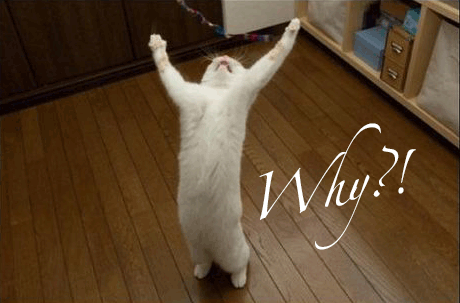
The 5 Why method to problem solving

why-god-why1  


Students often ask me, "How do I get better at Aikido?"  I pretty much answer them the same way Furuya Sensei answered me when I asked this question some 26 years ago, "You get out of it what you put into it."  Jigoujitoku (自業自得) is the old Japanese proverb equivalent of, "You reap what you sow" and this goes for the martial arts too.  If one wants to get better one has to put in the time and effort - It really is as simple as that.

But you might be asking, "How" do I do that?  Outside of coming to class consistently and constantly, one needs to put in their own work.  Whenever Sensei talked about doing something outside of class, he referred to it as "part of my own training."  A student once told me this story about how Sensei would try and grab exactly 100 pieces of copy paper in one grab and that he could consistently do it too and that Sensei told him it was part of his training to develop his intuition and his eye.  Another student told me how Sensei would clean all his calligraphy supplies and pack his bag the night before class and when he asked Sensei about it he said that he did it, "as part of his own training."

Doing something "as a part of one's own training" is something that one comes up with to make themselves better.  We identify an area of concern and come up with a strategy to overcome that insufficiency.  For instance, if one gets winded in class, maybe they stay for two classes to build up their stamina, take up running or try and lose weight.

To get to the root cause and develop a strategy to overcome it, one needs to know what the problem is first.  One method students might use to determine the cause of their deficiency is a method Sakichi Toyoda of Toyota came up with called the 5 Whys.  He said that any problem can usually be solved by asking the question, "Why?"  Asking the question "Why?" to each answer forces us to have to confront something that we are consciously or unconsciously avoiding or it forces us to have to think creatively as we think outside of dogmatic thinking.

Here is an example: Why 1: I get so tired in class - Why? Why 2: I am out of shape - Why? Why 3: I need to lose weight - Why? Why 4: I overeat - Why? Why 5: I skip breakfast so I am hungrier at lunch and dinner and end up making poor decisions

The fix: I will eat breakfast in order to help me make healthier choices at lunch and dinner

O Sensei said that the goal of Aikido training is Masakatsu Agatsu or "the truest victory is the one over oneself."  WE not our teacher, our spouses or our friends make us better.  Asking "Why?" enables us to get to the root cause of our dysfunction and thus become better and with time and effort gain a victory over ourselves.

It is my job to teach class, it is your job to make you good.  Therefore it becomes obviously true that as Sensei said, "You get out of it what you put into it."

The mark of a good student is one who does the right thing at the right time

bat copyProfessional baseball player Lefty Gomez once said, "I'd rather be lucky than good."  In the martial arts, it is the other way around.  We'd rather be good than to rely on luck.

To be good one needs training - they have to put forth the effort.  Putting the time in is what allows us to be "good" or in other words to be in the right place at the right time.

The guy in the picture above probably caught a few things in his time allowing him to reach out and block that bat.  However, I would argue that if he trained himself, he could've caught that bat rather than just deflect it.  If he had caught it, the crowd would have gone crazy and then everyone would be praising that one incredible feat.

Furuya Sensei used say, "The Way is in training."  He didn't say the Way is in being lucky.  It doesn't matter what martial art one does, training is the martial art.  We train day in and day out for just that one similar occasion so that our training can take over and we can shine, but the only reason why we do so is because we put in the time.  When teachers say that a student is good, what they really mean is that they do the right thing at the right time.  To know what the right thing and the right time is takes an immense amount of training.

If a student wants to be great at something then they need training - they need to put in the effort.  How does one expect to be great if they decide to skip class?  Timing is, as they say,  "everything" and therefore everything requires training.

Photo source: https://twitter.com/Hornerfoto1

Tomorrow at 9:00 am will be Furuya Sensei's memorial service

tsubaTomorrow the dojo will host Furuya Sensei's ninth meinichi or memorial service.  One of the three marks of existence in Buddhism is that of impermanence.  Warriors of old not only knew but embraced the fact that at some point their lives would end.  Rather than withdraw, sulk or fear this inevitability, they embraced it and thus were able to live their lives more fully.  Japanese warriors of old were fond of adorning themselves with subtle reminders of the values and beliefs that mattered most to them.  Japanese tsubas or sword guards were a favorite item to decorate with these symbols.  Below, Sensei explains this tsuba and how it figures into the transiency of life. I know everyone's lives are busy and that time has away of creating a sense of distance from things, but we are martial artist and martial artist are honorable people.  But, what is honor?  What does it mean for someone to have honor?  I know a lot of people talk about having honor.  Haven't you ever noticed that every martial arts movie is about honor?  The martial artists in these movies have to do something that they really don't want to do but they have to do it anyways regardless of the difficulty, odds or outcome.  That is honor.  Japanese Director Kinji Fukasaku said, "Honor is the last thing in the world you want to do, but you must do it."  Our duty as Sensei's students is to honor his memory - we owe him that much.

I hope that if you can,  you will come and remember Sensei tomorrow with us.  If you cannot, I hope that you will spend some time honoring him in your own way.

9:00 am: Memorial Service at the dojo 10:15 am: Grave site visit 11:45 am: Lunch at Golden Dragon (960 N Broadway, Los Angeles, CA 90012) Everyone is welcome to attend!

Sensei posted this to his Daily Message on September 1, 2006.  True Spirit of the Samurai:

Wonderful iron tsuba of the early 1700's.

Within the context of the sturdy folded iron with see the simple openwork designs which capture the true heart of the Samurai warrior. The design is of a cherry blossom, a snow flake, tansatsu (long stiff paper on which poetry is written). To the left, the double circle, "wa-chigai," represents the family crest of some proud and noble warrior family.

The cherry blossom is considered the symbol of the Samurai warrior - as it blossoms in its great beauty, the gentle breeze scatters the petals as they fall. The snowflake also represents the transiency of Life - it's momentary existence is expressed in its great beauty and delicacy.

With the feeling of the transiency of life, the warrior also pursues a life of culture and learning - the tansatsu represents the warrior's skill to express his feelings in poetry.

Nowadays, we only think of martial arts as punching and kicking and throwing people to the ground. So sad!


What does the noren mean?

NorenHere is a picture of the noren curtain hanging at the dojo's front door.  The design motif is noshi which are the decorative strips of abalone or paper strips that accompany the wrapping of gifts in Japan. These strips are supposed to symbolize prosperity and bring good luck. The Japanese love puns and so like many things Japanese there is a hidden meaning to this word noshi.  In Japanese, words can be written in roman characters (romanji), in hiragana, in katakana or in kanji.  In order to know the exact definition of a word one must know its kanji or its context, but without these the ambiguity opens the door for puns.

The kanji for the strips of paper that adorn gifts is 熨斗, but the word noshi can also be written as 伸し which means to extend or expand.

To noshi or extend in an Aikido sense usually refers to extending one's ki (氣) or internal power, but it could also be extending or stretching one's self as a means to achieve more, be better or train harder or as a means to achieve prosperity as it circles back to its original meaning.

In Aikido, we try and expand our ki throughout the entire technique.  Beginners struggle to keep it on and from deflating.  More experienced practitioners can keep it extended a little longer while an expert can keep it expanded throughout the entire technique, but only a master can keep it extend throughout their entire life.  Our lives are a series of expansions and contractions, but a true master is extending even while it appears they are contracting.

So one can see how noshi is a nice metaphor for not only training, but life too.  Enjoy your day and keep extending!


"The falling leaves doesn't hate the wind." - From Zatoichi, the blind samurai

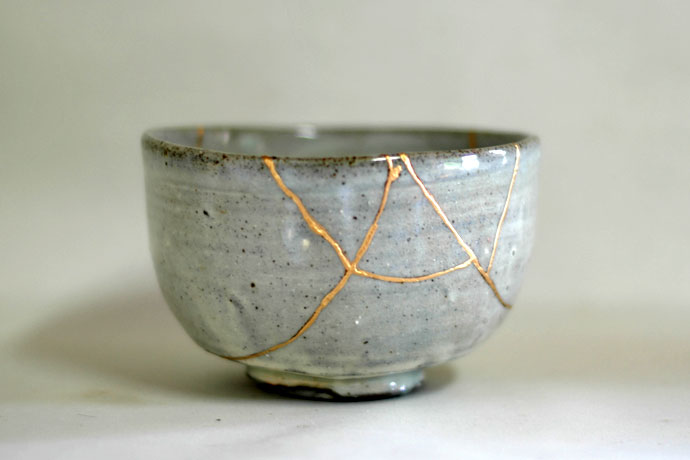
Kintsugi-bowl-honurushi-number-32Life is a never ending cycle of falling down, healing and getting back up.  In Aikido we call that taking ukemi.  As these scrapes, bumps and bruises heal, we have the tendency to try and hide them as if this damage some how defines us in a negative way.  These battle scars do more than define who we are - they makes us into who we become.  If we try and hide them, then we tend to take that negative path in life.  If we display them for all too see then we can use them as fodder to make us stronger. It is natural, I suppose, to want to hide one's flaws and only project one's accolades or strengths.  In chado or Japanese tea ceremony it is the exact opposite.  One's flaws are seen as the things which makes us human and this can be clearly seen when a tea bowl is broken.  Rather than throw it away, it is sent out to be repaired.  The bowl is painstakingly put back together with a sort of gold glue called kintsugi (金継ぐ) or gold patch.  However, the bowl isn't repaired back to "new" where one wouldn't even be able to see where the original damage was, but in some sense made better by the repair.  This repair, therefore, enhances its beauty.

In Aikido, we fall down and we get back up - it is part of the training.  The trials and tribulations of life's journey do add up, but they make us who we are - the person we have become.  We can either get back up and use it to make us stronger or hide them and make ourselves weaker.  We are all infinitely stronger than we think.  How do I know that?  Well, you are still here, right?

Below is a nice video explaining kintsugi in further detail.

https://vimeo.com/90734143


Listening = Learning

“Listening is a magnetic and strange thing, a creative force. The friends who listen to us are the ones we move toward. When we’re listened to, it creates us, makes us unfold and expand.”- Karl A. Menninger

https://www.ted.com/talks/julian_treasure_5_ways_to_listen_better?language=en

In the TED talk above, author Julian Treasure discusses the concept of listening.  He said, "every human being needs to listen consciously in order to live fully -- connected in space and in time to the physical world around us, connected in understanding to each other, not to mention spiritually connected, because every spiritual path I know of has listening and contemplation at its heart."  Doesn't that sound like the definition and philosophy of Aikido?

Conflict usually happens somewhere around the intersection of misunderstandings, hurt feelings and emotions.  Could listening be the antidote for conflict?  I don't know for sure but it sure sounds like it by the way Julian Treasure talks.

In Aikido, there is no fighting, struggle, collision or any other confrontation.  In order to truly do Aikido, one must embrace O Sensei's philosophy of non-violence at every level and that includes how we listen which is an extension of how we think and what we believe.

"You can always fall back on the basics." - Rev. Kensho Furuya

Today's hottest NBA basketball team just revealed their secret to success - the basics.  This season, the Golden State Warriors have a current record of 51-5 and are chasing Michael Jordan's 1996 Chicago Bulls record of 72-10. In a recent podcast, one of their players, Andrew Bogut revealed that in their training camp their coach Steve Kerr said, "We're going back to the basics."   They spent a large portion of their training camp on rudimentary passing and shooting drills.  The result is obvious as the Warriors have the league's best record and are poised to repeat their championship run from last year.

In the video below, watch how the Warriors spread out their opponent's defense with just their passing.

https://www.youtube.com/watch?v=DHPD1HZg8-I

The fundamentals are something that Furuya Sensei often spoke about.  He once said, "When you get lost or confused, you can always fall back on the basics."  This is something that has always stayed with me and something that I try and instill in my own students now.  Strength and speed will fade with time, but technique is something that one can always be improve upon.

What are the basics?  Footwork (ashi-sabaki), body movement (tai-sabaki), posture and the basic techniques of tenkan kokyu-ho, ikkyo, nikyo, sankyo, yonkyo and some few other basic control holds and throws.  Master these and one will master Aikido.

If you want to read more about the Warriors, read the inspiration for this article here: http://finance.yahoo.com/news/steve-kerr-designed-nbas-most-223710921.html

Be brave and do something

nothing  


Author Richard Powell believes that the Japanese concept of wabi-sabi comes down to these three simple realities: "Nothing lasts.  Nothing is finished.  Nothing is perfect."  They are based on the the three marks of existence in Buddhism which are suffering, impermanence and the non-self.

To me this understanding of wabi-sabi is adequate as an abstract concept but the thing about wabi-sabi is that it is the manifestation of the abstract which makes it wabi-sabi.

There is a famous story about Sen Rikyu who was the founder of the tea ceremony.  Rikyu's son hosted a tea gathering for his father at his home.  He had his wait staff clean the entire estate to perfection and he himself looked after the details for the ceremony.  Everything was perfect.  When Sen Rikyu arrived he noticed how pristine the roji or walkway was to the chashitsu or tea house.  Rikyu paused and said, "Something is missing."  At that moment his son realized his mistake and shook the tree so that some leaves fell and landed on the roji.  Rikyu then smiled and said,"Perfect."  His son understood the abstractness of making things perfect, but it was the imperfectness of the leaves which made it wabi-sabi and thus imperfectly perfect.

I would complete Powell's assertion this way:

Nothing lasts. Nothing is finished. Nothing is perfect. Now go do something.

The first three statements are abstract which could bring about a sense of disillusionment, but it is the last statement I think brings it all together.  Yes, nothing is permanent, finished or perfect but that is precisely why it is still necessary to do something.

There is a moment...

komorebi  


There is a moment in training when everything seems to just come together.  This moment is different for every person.  It could be when someone like the teacher or another student says something that brings something together kind of like an "ah-ha" moment.  Or for other people it just happens during the technique when everything just seems right and the technique just flows or just works.

I can't really explain this moment.  It is the instant where the universe just lines up and everything is right.  We call it a moment, but it is really more of a feeling.  In Pulp Fiction, Samuel L. Jackson's character, Jules referred to it as, "A moment of clarity."  The best way I can describe this moment is komorebi (木漏れ日) or the moment that the light shines through the trees.

Komorebi is something that we too have a difficulty explaining, but fortunately it happens serendipitous many times throughout the day if we are aware and present enough.  If we are aware enough, then we can partake in something wonderful that will never happen exactly the same way again like the seemingly benign rays of sunshine breaking through the trees.  To take in this fleeting phenomenon is to be aware of the fleetingness of life or ichigo ichie (one time, one meeting).

These komorebi type moments happen all the time and all around us, but we need to be present to be aware.


"The first wealth is health." - Ralph Waldo Emerson

I hope that you are all well.  I really do appreciate all of you who read my insignificant words here.  Most of these posts are just a way to amuse myself. Since the beginning of the year I have been sick with a cold three times (it's the cost of having kids).  Each time seems worse than the last.  Being sick this last time made me really begin to appreciate what it is like to be "healthy."  I wondered, "What would life be like if this became my 'normal' and I never got well?"  Having that moment really made me think and appreciate that, today I am healthy and able to enjoy my life but there are those who are not so lucky to be well.

I got an email from a dear friend in China who's wife has gotten very ill.  William (Bill) Gillespie was a student at our dojo all throughout the 90s.  He is in the black belt class two ahead of me and one of the first people to beat me up on my second day - thanks Bill.  His wife's name is Angela and this is her second bout with a life threatening illness.  It sounds cliche, but she is one of the nicest people and doesn't deserve this, but this time it is true.  Bill is currently in Beijing and the Chief Instructor of Beijing Aikikai.   His wife (who is totally awesome and a super nice person despite Bill's shortcomings) is in the hospital battling for her life and needs our support.  They are Aikido people, we are Aikido people and therefore we stand together.  If you can, please donate any amount that you can afford.

To donate or read more about Angela's condition click here: https://www.youcaring.com/angela-im-526250#.VssrQ_N8AvY.email


An interview with Tamura Shihan

A super interesting video interview with Tamura Shihan who was O Sensei's favorite sword ukes.  Tamura Sensei was a huge propagator of Aikido in Europe and especially France.  Perhaps O Sensei liked his sword ukemi because Tamura Shihan's father was a Kendo teacher.  Tamura Shihan passed away in 2010 at the age of 77.  I found this interview incredible enlightening.  Anyone interested in studying Aikido should watch this video, but it also might be incredibly helpful to students who already practice Aikido.  He succinctly sums up not only training but motivation as well. https://www.youtube.com/watch?v=SPeSKlkKPOg

Know thyself

seek

“Do not seek to follow in the footsteps of the wise. Seek what they sought.” - Matsuo Basho

Everyone seeks their own path.  Each of us is simultaneously a guide and companion on life's journey.  To think we are above or ahead of others is a delusion.  We are all on the same path.  This quote by Basho illustrates how we must think.  If we live for others or try to be someone else, we will fail.  Beginners, experts, students or teachers alike seek the same thing - to know themselves.  Enlightened people all over the world and from different cultures all advocate the same thing - know thyself.  "Who am I?" is the question that every person throughout time has sought to answer.

Victory comes not in defeating others, but as O Sensei asserted in defeating ourselves. True victory comes when one knows at their core who they are.  From this place of knowing one's self, our altitude in life will be limitless.

Nice video of Nakayama Sensei teaching forward ukemi

Nakayama Sensei and Furuya Sensei were good friends.  Nakayama Sensei has visited the dojo and taught class many times.  In this video, he gives a good explanation of the hows and whys of Aikido style forward rolling or zenpo kaiten ukemi. https://youtu.be/GltJZM5LM2s

Do you gamble?

Recently, I was watching a martial arts movie called Brotherhood of Blades and there was an interesting line where the hidden villain says to one of the other bad guys, "Those who rely on luck are gamblers."  That was an interesting line in that I felt was relevant to martial artists. Luck implies that there is some part of engaging our opponents which is completely random and out of our hands.  While this might be true, this randomness is something a martial artist cannot afford to rely upon.

A warriors entire training, regardless of level, is spent shoring up holes and closing up openings.  A good martial artist is at least five to ten steps ahead of their opponent while a master is said to be 10 to 20 depending on the martial art.  A confrontation is like a chess game where one is constantly thinking about where their openings are and where their opponents will attack.  For instance, the Norwegian chess player Magnus Carlsen is said to always be 15 to 20 moves ahead of his opponents.  Beginners spends all their time closing their openings while a master is said to be in the business of create openings.

In gambling, there is no such thing as winning all the time which is probably true for martial arts as well.  However, in the martial arts if one loses, they usually lose their life or the life of someone close to them.  Therefore, one can see that any amount of error is unacceptable.

Since as martial artist we are not gamblers then we must be pragmatists in our outlooks.  This practical way of thinking assumes that our challengers are working hard to defeat us and thus we must work harder.  There is no substitute for hard work, planning and preparation.  A saying that I like from Scientific American many years ago that I like is apropos, "You fail to the level of your preparation."  Generally speaking, when one puts in the effort they are successful.  If there is luck, then it is that sliver of an opening between two people who are both thoroughly prepared but most of us will rarely encounter that.

The philosopher Seneca said, "Luck is what happens when preparation meets opportunity."  Since we cannot afford to gamble then it is best that we get started...


Happy 401st post

"Imagine fish swimming in a shallow pond, just below the lily pads, thinking that their “universe” is only two-dimensional. Our three-dimensional world may be beyond their ken. But there is a way in which they can detect the presence of the third dimension. If it rains, they can clearly see the shadows of ripples traveling along the surface of the pond. Similarly, we cannot see the fifth dimension, but ripples in the fifth dimension appear to us as light." - Michio Kaku Another way to experience this fifth dimension is with love. Things like light, gravity or love just to name a few are nature's laws.  O Sensei understood this and that is why he created Aikido. We are all swimming around in our ponds. Light shines through but it is intangible just as love is but just as with light one mat not be able to understand its origins but we can still feel its affects.

Have a great President's Day.

To catch their timing

timing  


In life as in Aikido, one must have timing.  A good Aikidoist will have average timing, but a great Aikidoist will have phenomenal timing.  But, what is timing?

Timing is something that is difficult to explain.  Google defines it as, "The choice, judgment, or control of when something should be done."  That definition is something that one can understand but still not know.  Timing can be thought of as just the right point when something extraordinary can happen.  A good metaphor might be the moment when darkness turns into light or when light changes into darkness.  When the day changes over, there is this place and within that place exists a subtle moment when it is neither dark nor light.  If one is aware then one can catch a glimpse of its immense beauty.  To the uninformed, the day just became night or the night just became day.

Every person has some sense of timing - it is innate.  How do I know that?  Does your heart beat?  Then you have timing.

It doesn't matter if one is studying acting,  Aikido or driving - timing is important.  To develop that sense of timing requires training.  Lots and lots of training.  In training, one develops their body first and then their mind second and with these developments comes a sense of awareness.  This awareness enables one to almost see the timing, but it is a feeling thing more than a seeing thing.  Seeing it is too late.  Just as in when the day turns over, you feel it before you see it and then it is gone.  In sports it is called being in the zone.  This "zone" type awareness enables the athlete to almost control the moment because their awareness creates this sense of vastness.  Athletes report things like the ball being 10x larger or the goal being infinitely bigger enabling them to score with ease.

When one's awareness is developed then one is able to seize the moment and that is why people often say, "I caught the timing."