
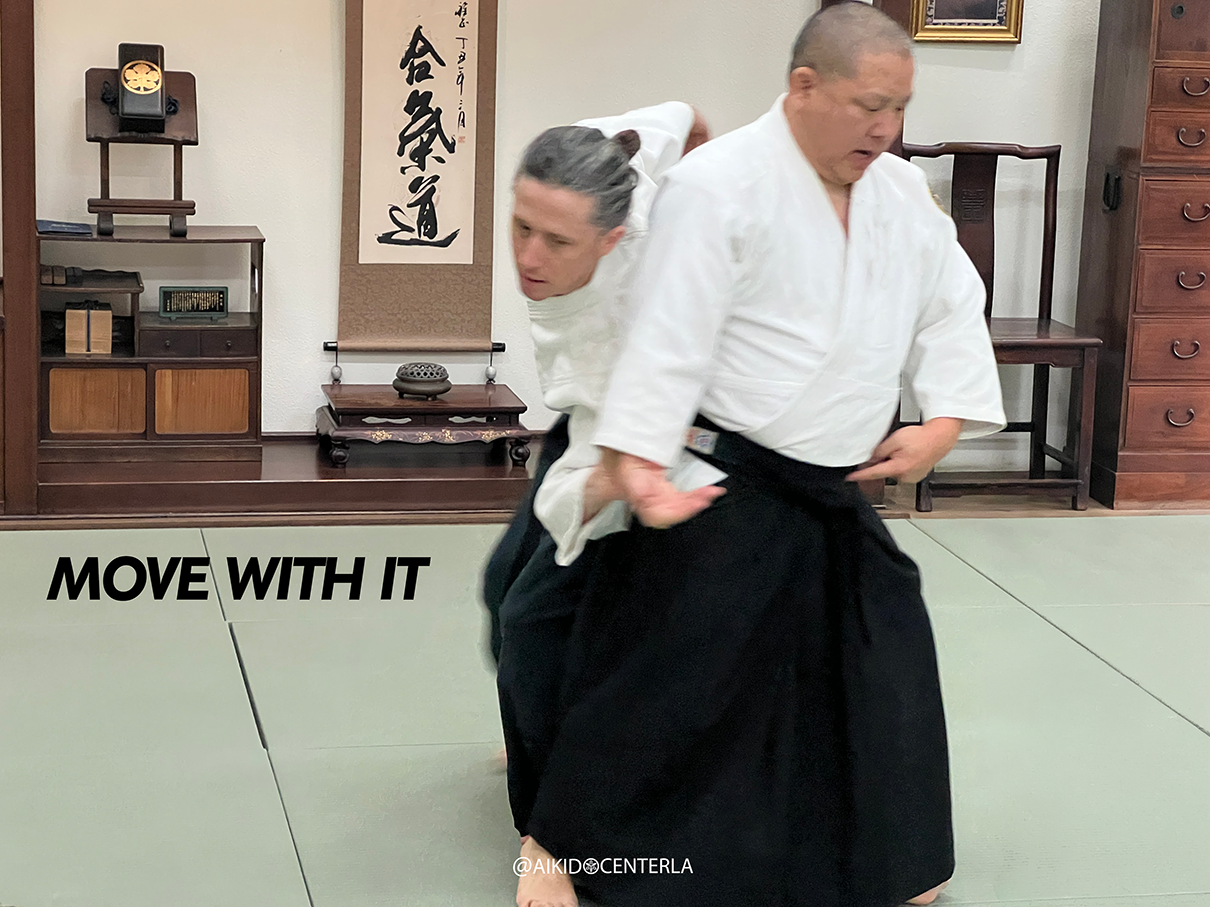
Go With the Flow
In the movie Dr. Strange, the Ancient One says, “You cannot beat a river into submission. You have to surrender to its current and use its power as your own.” Albeit a movie, this statement parallels Aikido training.
In our particular style of Aikido, we emphasize movement. At the tachiai (立ち会い) or “initial moment of contact,” we don’t want to collide with our training partner. If we are late, don’t have the proper timing or spacing or focus too much on the upper body, there is a chance that we may collide with our opponent. By colliding, I mean that there is a point where movement stops and we struggle. This struggle can mean literally running into someone, but it is anything where the movement of the technique stops. Generally speaking, the only time when our movement should stop is when the opponent is being pinned or has been thrown.
There are two sides to every technique: the uke side or “the one who receives” the technique and the nage side or “the one doing” the technique. Equally, there is a certain amount of energy both practitioners have to bring to the execution of the technique. This can be thought of as resistance vs. resistivity.
The uke applies resistance which is “an extrinsic property of a specific object.” This is the structure, strength and momentum of the attack which is specific and required to do any particular technique. Without this resistance, the movement becomes flippant and the technique loses its martial quality. On the nage’s side, they too bring resistance, but it is more of a resistivity or “an intrinsic property of the material itself.” This is the nage’s internal fortitude. If the nage is attacked and lacks resistivity, then their movement will collapse under the weight of the uke’s attack or resistance. Don’t get me wrong, the nage also has to have a certain amount of resistance too but not as much as we think and it is more a sense of physicality than muscle strength.
It is important to have this this inner resistivity because at the moment of the attack, most of us will be surprised and this shock will impact our energy. It is interesting, “to be irritated,” the Japanese say kigatatsu (氣が立つ) or “our ki stands up” and when they say, “to be calm,” they say “our ki sits down” or kigasuwaru (氣が座る). Resistivity is a cultivated practice. Most of us, our natural tendency is to resist. Thus, every time we face off against our partner, we are getting a chance to cultivate this internal resistivity.
The more resistivity we have, the less we have to rely on external resistance and physical force. Resistivity enables us to have the wherewithal to move and align with the power of the attack and not fall prey to the attack. Ideally, the more inner resistivity we have, the less we have to rely on external resistance and thus we can quickly ki wo torimodosu (氣を取り戻す) or “regain our composure.”
In Aikido and in Life, the struggle is real. Every day, we are buffeted by things which we cannot control. However, the amount and magnitude of the struggle is dictated by how much resistance we choose to give it. Someone once said, “Everything happens for us.” Giving that aphorism credence, there is nothing to resist or in other words all we need to do is “surrender to the current” as the Ancient One advocates. The best Aikidoist don’t resist, they ki no nagare (氣の流れ) or go with “the flow of ki.”
Today’s goal: Cultivate the inner strength to flow with whatever confronts you rather than resist it.
Watch this short of Ito Sensei talking about equanimity