
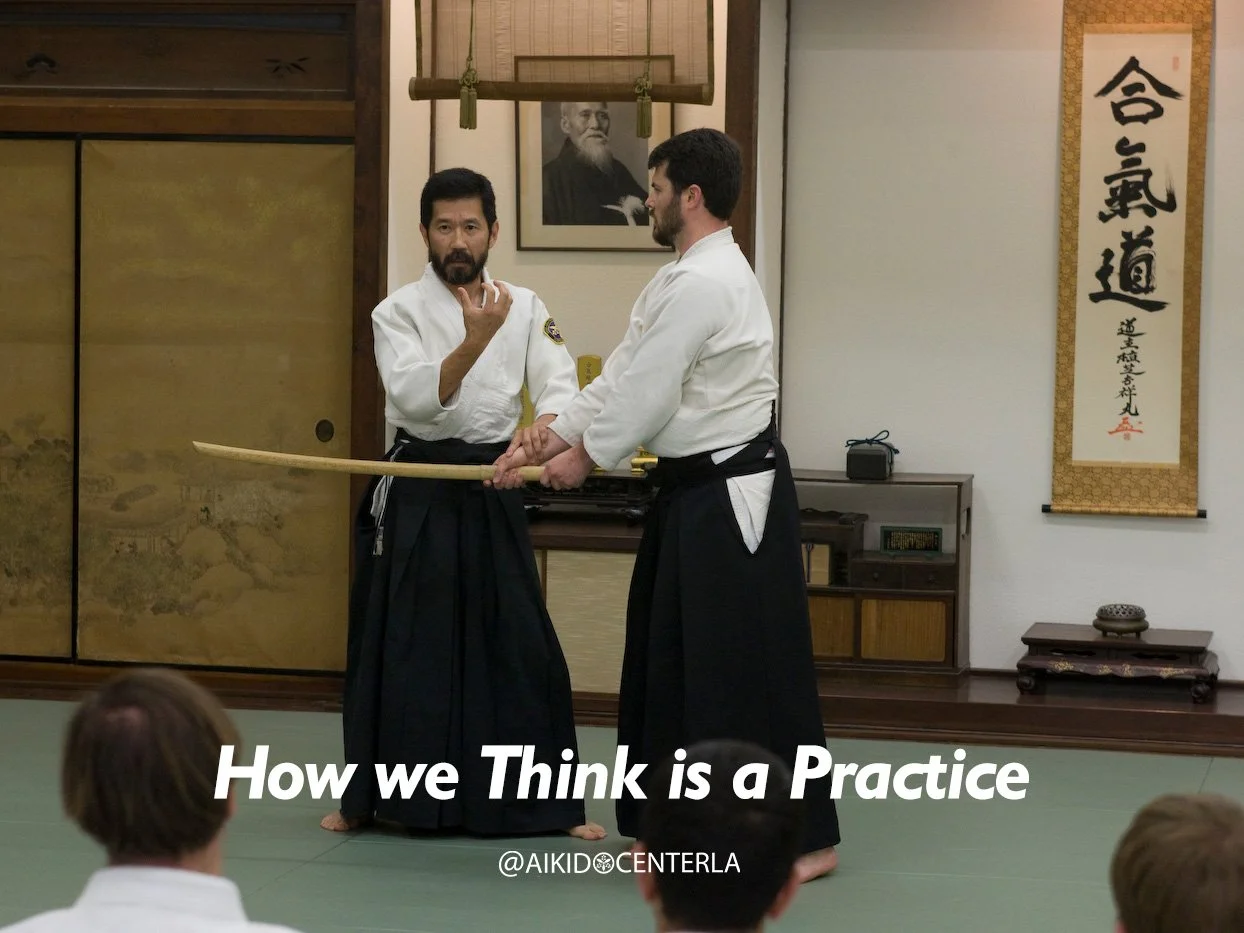
From the Aikido Center of Los Angeles’ Aiki Dojo Message - Thinking Makes it so
“There is nothing either good or bad but thinking makes it so.” - William Shakespeare’s Hamlet
It is thought that like begets like and thus negativity begets negativity and positivity begets positivity. If that is even remotely true, then how or what we think can have a real impact on our daily lives.
In Japanese, “how or what we think” is called kangaekata (考え方). Kangae means “thinking” and kata means “way” or “method.” How or what we think creates more awareness of those same things and thus it becomes a pattern. If we have a jaken (邪見) or “an evil point of view,” then all that we see will be evil.
The famous sword teacher Yagyu Munenori said, “Conquering evil, not the opponent, is the essence of swordsmanship.” When we examine this statement, evil and opponent are listed separately. Therefore, one could posit that one exists outside and the other inside and that training in swordsmanship could not only help us dispatch an opponent but also help us to dispel the evil that exists inside of us.
Obviously, being a sword teacher, Yagyu was stating this in the context of learning swordsmanship. He used the word evil or at least the translator did to caution his students that training can have a way of causing them to be overly negative.
How this happens is that in the beginning of our training, we are supposed to train ourselves to notice openings and exploit them. This way of thinking gives rise to negativity because we are always looking for what is wrong or incorrect. Focusing on the negative enables us to be shrewd and maybe even successful but it can also create a lack of heart or conscience which justifies Yagyu’s use of the word “evil.” Later in our training, we come to realize that this negative outlook has seeped its way into our everyday lives and when left unchecked can give rise to cruelty or bullying behavior. Negativity gives rise to the need for balance where negativity and positivity act like weights on a scale balancing each other out. Thus, we must temper our negativity or the ability to harm others with positive things like care, compassion, or kindness.
Furuya Sensei called this balance saikan koubai (歳寒紅梅) or “the elegant apricot flower and the strong plum blossom.” He said, “Saikan koubai means to focus too much on war makes us rough and crude while the emphasis on too much beauty makes us weak.”
In Chinese philosophy, the taiji or yin/yang symbol has a dark side and a light side and within each side there is always a dot of the other that serves as a reminder that all things contain the seed of their opposite and that each side is never completely yin or yang, dark or light.
Every day we are buffeted by things that can seem dark, negative or horrible and most times they seem out of our control. Training teaches us that we cannot allow ourselves to follow this negative path. Here, it comes down to perspective and what we choose to focus on. If we carry a hammer, all of our problems will look like things that can be only solved by hammering. Remember, according to the Tao, there will be some element of light. Thus, how we choose to think is a practice with its good days and bad. The hardest part is not to dwell because balance is never static and is always moving from one side to the other. The trick is to never allow ourselves to rest on one side or the other.
Today’s goal: If you tend to see things too negatively, try and create a practice of seeing the brighter and more hidden side of things. Remember, like begets like.