
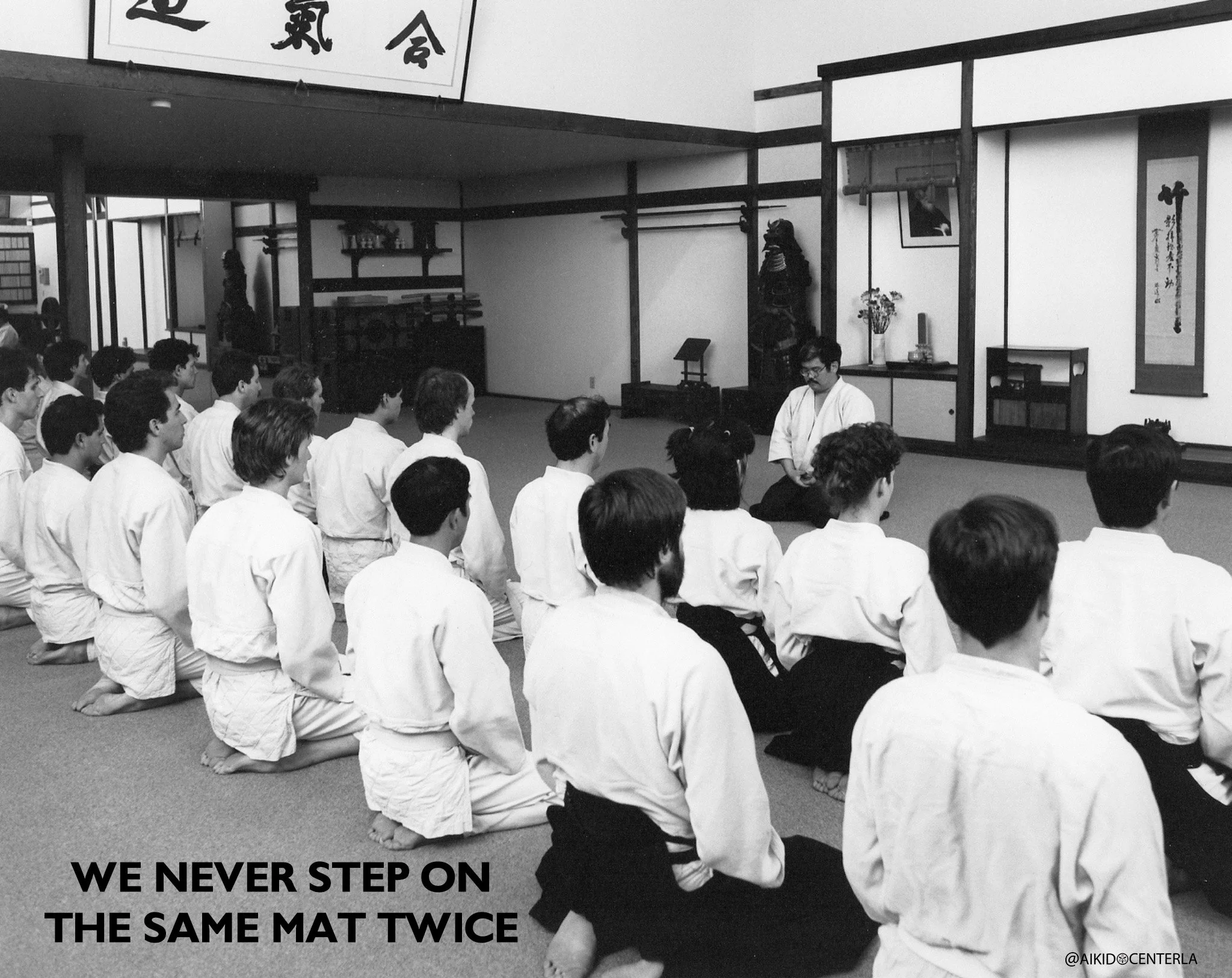
From the Aikido Center of Los Angeles’ Aiki Dojo Message - We Never Step on the Same Mat Twice
Aikido training is a process of constant refinement.
In Japanese, one way to talk about this process of self-improvement is jibunmigaki (自分磨き). Jibun means “self” and migaki means “to polish” or self-improvement. So, ideally, it means “to polish the self.” The old or outdated kanji for “to polish” was (研き) which also meant “the study of.” With this kanji combination, it seems that our development is not so much “polish” but “the study of the self.”
Our technique in Aikido is supposed to be constantly under refinement. It only deteriorates if we neglect it or when we can’t see its true state. James Doi Shihan talks about this idea that we are not necessarily improving but constantly managing the decline. This is true but not from the standpoint of it being bad. Decline is natural as we age, train less, or stop training all together. What makes Aikido so interesting is that every day, we have to figure out how to do Aikido with the tools that we woke up with. For instance, if our backs are tight, we have to figure out how to do Aikido in that state. Training teaches us that nothing is static meaning that nothing today is as it was yesterday or as it will be tomorrow. As Heraclitus said, “Everything is in flux.” Our movement is never a hard construct but more a living ever flowing thing. It will need work here and there and just about everywhere like plugging holes in a dam but that is what makes Aikido so infuriating but interesting.
In training, to be in a state of constant refinement, is to have questions. Mostly the questions are about the details. Here are some questions to start you off: How was I breathing before, during, and after? Where were my feet supposed to be and what is the state of my balance? Where is the kokyu in the technique or where exactly was I supposed to be using it? Where am I supposed to be positioned in relation to my partner before, during, and after the technique? What should my state of mind be? What part of my body did I use to make the technique work? What is the correct spacing for this technique? What was the timing supposed to be?
This list of questions is not exhaustive. It is just something to get you started. Every student and teacher alike should have questions that they are actively trying to solve in their Aikido. Some are physical, some are mental, and some can even be spiritual. The most important thing is that you are actively cultivating questions and trying to solve them on the mat - that is constant refinement.
In Aikido and in Life, none of us are the people that we were yesterday. Life is complicated. The moment when we think we know or theorize something to be, that is the moment that we have stopped moving and have stopped growing. People and circumstances are way more complicated and convoluted than we will ever know. To grow is to realize that everything is in a constant state of flux and thus we should give grace rather than pound them with violence.
Heraclitus said, ”No man ever steps in the same river twice.” We never step on the same mat twice because we are never the same person that we were yesterday or will be tomorrow - we are all in a constant state of flux. Training and Life are about being in a constant state of proactive refinement. That is why Furuya Sensei used to regularly say, “The Way is in training.”
Today’s goal: Step onto the mat with a question, not an answer.
If this resonated with you and you've been curious about training — we'd love to have you on the mat. Your first class is free! Come train with us →Free Class