From the Aikido Center of Los Angeles’ Aiki Dojo Message - The Spirit of the Technique
“Each Aikido technique holds a secret which can only be unlocked by effort.” - Rev. Kensho Furuya
In Aikido, we are supposed to not only be developing our bodies but cultivating our techniques as well. Technique in this context is more about methodology or “how one does Aikido.” Generally speaking, the Japanese word for “technique” is waza (技). But in Aikido, we are not just trying to develop the physical skill of technique, we are trying to cultivate something called shingi (心技) or the “spirit within the technique.”
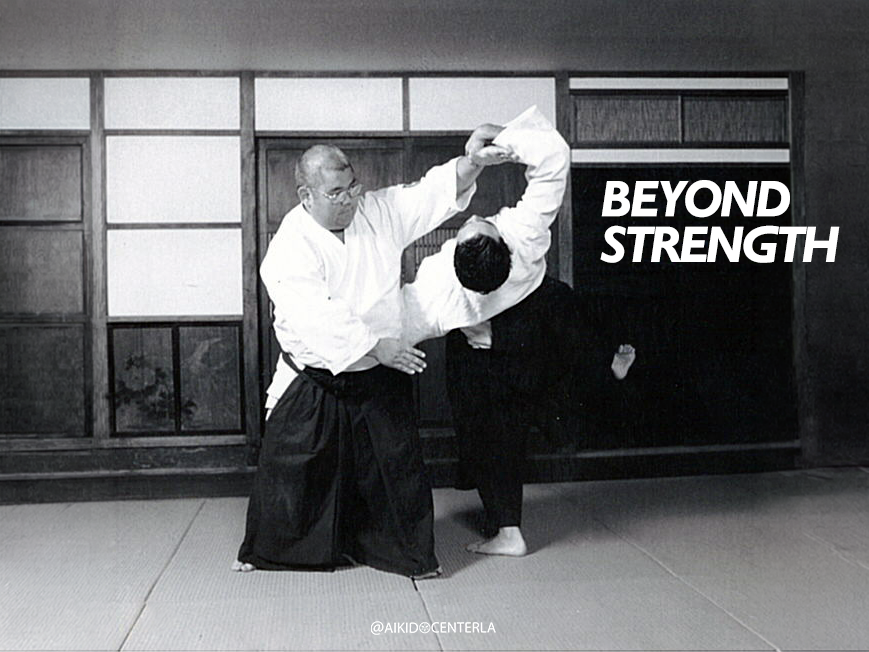
For the first few years of our training, we primarily focus on tai-iku (体育) or “learning and understanding” Aikido with our bodies. At this point, the success of our Aikido technique primarily come from ryoryoku (膂力) or “the strength of our muscles. The problem with strength is that it is a double edged sword. It can make the technique work but the moment that our physical strength fades from fatigue or age, so goes the techniques’ effectiveness. That is why, as we build physical strength, we should also be going deeper and cultivating the spirit of the technique as well. The spirit of the technique is more than mere effectiveness.
Shingi is a deeper point in the cultivation of the technique, and it is where the “technique” of the technique ceases to rely on muscle strength. I do believe that the spirit of the technique is still physical but not in a muscle strength sense. There are two parts which make up a technique: form and principle. Form is the step by step physical movement. The principles are things like timing, spacing, kuzushi, etc. Together the form and principle create shingi. Shingi can be thought of as the intersection between the physical and mental movements, and it happens as they say, “when the technique has entered into your body.”
Every day in class, students should try and focus on making their movements as succinct and correct as possible. Succinct means no wasted movements or nuances. Correctness can be subjective but it is supposed to be objective, and it is our job to get our movements as close as we can to the example that the teacher is demonstrating. Until the movements are second nature it is important that we train consistently and constantly so that we don’t fall back into muscling the technique.
The Japanese say Kekkyoku jitsuryoku ga katsu (結局実力が勝つ) or “Real ability wins in the end.” The word in this sentence that is the most interesting is jitsuryoku (実力) which means “true ability” but people also use it to mean “true strength.” Jitsu (実) means “truth” but it also translates to “sincerity,” “honesty,” or “substance.” Thus, our greatest strength is not in trying to defeat others with brute force but in the pursuit of defeating ourselves to become people of true substance.
Every day we are buffeted by forces that are beyond our control, but we can control our response to them. True power is not in exercising strength in defeating those who annoy us or confront us but in demonstrating the true strength of showing restraint. Training has so many layers; go deeper and unlock the true spirit of the technique.
Today’s goal: Use less force. In the dojo, trust the principles instead of muscle; in life, practice restraint instead of forcing the outcome.
Watch this TED-ED video to better understand practice