Editor’s note: This article originally appeared in the July 2026 issue of El Budoka magazine. It was kindly translated by Santiago Almaraz Sensei. Read Secuencia De La Tecnica in Spanish
Technique Sequencing
“Once a fight has started, if you get involved in thinking about what to do, you will be cut down by your opponent with the very next blow.” - Yagyu Munenori
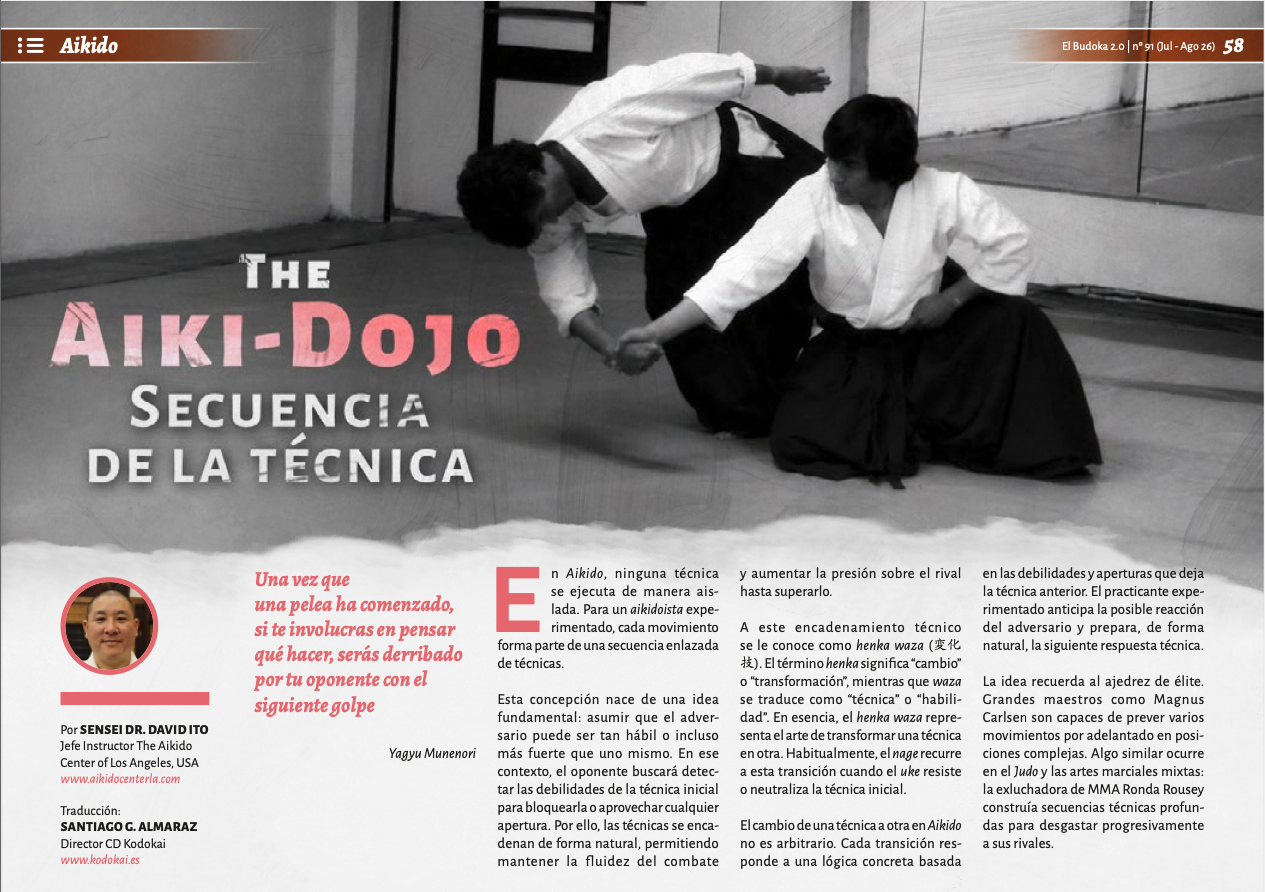
In Aikido, no technique is done singularly or by itself. In the mindset of the trained Aikidoist, every technique is or should be done as part of a sequence of techniques.
The reason for this rationale is because we are supposed to have the mindset that our opponent will be as skilled or greater than us. If that is the case, then they will know where the weaknesses are in the technique and will try and try to exploit it or block us at that opening. To circumvent their attack, we set up our techniques to flow logically from one technique to another so that we can overwhelm our opponent and eventually overtake them.
The flow from one technique to another in Aikido is referred to as henka waza (変化技). Henka means “change” or “transformation” and waza means “technique” or “skill.” Ideally, henka waza is the skill or art of transforming one technique into another. Typically, the nage moves from one technique to another when the uke resists or jams the initial technique.
The change is not arbitrary or predetermined where the choices and the changes are done for no reason. The sequences are linked together based upon where the logical weaknesses or openings are in the technique. Knowing that they know, we think ahead and set up the next logical technique in the place where the opponent plans to attack us.
In chess, it is commonly thought that elite grandmasters like Magnus Carlsen can supposedly calculate three to five moves ahead in complex chess positions. Carlsen has also bragged that he can “see” somewhere between 15–20 moves ahead in forced, tactical, or endgame situations.
This is similar in Judo as Judoka and MMA fighter Ronda Rousey's Judo technique is widely considered to be three to five techniques deep. Her sequence is designed to attack and wear down her opponents as they defend each one of the techniques in her sequence.
Just about any first year Aikido student can muddle their way through a predetermined set of techniques that was put together with no real thought. However, true henka waza is a high level skill that one only truly starts to cultivate around 4th or 5th degree black belt. A good technique sequence should be somewhere around five to six techniques deep. Henka waza is a demonstration of not only the practitioner’s ability to stay calm and be spontaneous but it is also a test of the practitioner’s knowledge of the techniques.
The telltale sign of a good henka waza is that the practitioner looks calm, cool and collected. In Japanese, this is called seichu no do, do chu no sei (靜中動 動中靜) or “movement in calmness, calmness in movement.” It is almost like moving meditation with a calm state of mind but there is also an efficiency to how one moves and uses their bodies. It is as if the body moves with a sense of calm and grace and only utilizes the minimalist amount of movement and energy. We cannot meditate our way here or fake it. This “movement in calmness, calmness in movement” is something that is only attained at the end of tens of thousands of repetitions.
The reason why it is a higher black belt level skill is because the practitioner must know the techniques so well that they have an almost unnatural sense about them. It is only with a precise knowledge of the techniques that the movement becomes almost intuitive. Not intuitive in a supernatural sense but in a subconscious way. Our bodies “know” and act so fast that it seems intuitive. It is said that subconscious thoughts and actions are processed at roughly 11 to 400 million bits per second and can precede conscious awareness by around 300 milliseconds. So it seems intuitive. This technical intelligence is built upon hundreds if not thousands of hours of technique repetition. From here, the practitioner knows the techniques so well that they not only know the mechanism of how the technique works but also the places where it is vulnerable and where the opponent will most likely try to attack it. From this knowledge, they feel not know what would be the next best technique in the sequence.
There are three ways to create the next technique in a henka waza sequence. The first is the most basic way. If we know the technique extensively enough then we should know the mechanism of how it works and we should know where its weaknesses are as well. We then stitch together our sequence because we are ready to move to the next logical technique based upon knowing that the opponent knows where to try to attack the technique. This is the level where we see kata (型) or “a standard form of a movement” in other martial arts.
The second is by set-up or trap. Since we know that they know, we purposefully create a “opening” or suki (隙) and lay a trap for our opponent. After all, Sun Tzu’s core tenet from The Art of War is "All warfare is based on deception.” Our opponent arrogantly sees an opening not knowing we created it and tries to capitalize upon it and thus fall into our trap. We don’t know which technique trap they will fall for and thus we need to make our sequence as deep as possible.
The third is by feel or intuition which is the hardest way. It is hard because we have to know without knowing without conscious thought. At this level, chess grandmasters uses high levels of intuition and pattern recognition and and have a sense or feeling for what is going to happen next. The farther one thinks ahead, the more conscious thought can’t be used. Remember, conscious thought is slow, intentional, and analytical and has been clocked at around 40 bits per second while subconscious thought is fast, automatic, and associative at speeds of up to 400 billion bits per second. So, if you have to think about the next step, it is not intuitive. We are calm and have trained to know the technique. Now we allow the feeling to guide the next technique in the sequence based upon the feedback we get from our opponent’s body language, reaction and movement just to name a few. At this level, it’s as if we kokoro wo yomu (心を読む) or “read” our opponent’s thoughts.
People who follow the Way of Aikido believe in ki no nagare (氣の流れ) or “the flow of ki” energy. This sounds mystical but we can see it physically in our henka waza as our ki flows from one technique to another which makes it look almost supernatural. But this isn’t magical, it is merely the result of years and years of training and thousands upon thousands of repetitions. True skill lies in meeting adversity calmly and with poise and power and we do that with our henka waza and the depths of our technique sequencing.